How to Choose the Right Online Shia Quran Teacher for Your Child
If you’re a Shia parent living in the UK, USA, Canada, Australia, or anywhere without an easy drive to a Shia mosque or Islamic center, you’ve probably already run into the same frustration: there’s no shortage of “online Quran teacher” results when you search, but almost none of them mention Shia teachings, Tajweed qualifications, or anything specific enough to tell you whether your child will actually be taught properly — or just handed off to whoever’s available that day.
This guide walks through exactly what to check before you commit to a teacher, so you’re not left guessing after your child’s third or fourth lesson.
Why This Decision Deserves More Than Five Minutes
A Quran teacher isn’t just teaching pronunciation. For the first several years, they’re shaping how your child relates to the Quran — whether it feels like a chore to get through, or something they genuinely look forward to each week. For Shia families especially, there’s an added layer: you’re not just looking for any Quran teacher, you’re looking for one who understands and reflects Shia Ithna-Asheri teachings, so your child isn’t quietly absorbing a different sectarian framing without you realizing it.
That’s a real risk with generic Quran platforms. Many are built for a broad Sunni-majority audience by default, and “Shia-friendly” often just means the teacher won’t object if you ask — not that they’re actually trained in Shia jurisprudence, recitation style, or the broader curriculum (Tafseer, Nahjul Balagha, Sahifa Sajjadiya) that Shia families typically want covered eventually.
What to Actually Check Before Choosing a Teacher
1. Ask directly: is the teaching grounded in Shia Ithna-Asheri teachings, or just “Quran in general”?
This should be an easy yes with a real answer, not a vague reassurance. A teacher who’s actually trained in the Shia tradition should be able to tell you, unprompted, how their curriculum progresses — from Qaida, into Tajweed, and eventually into Tafseer-ul-Quran and texts like Nahjul Balagha or Sahifa Sajjadiya. If they can’t describe a path beyond “we’ll just read Quran together,” that’s worth noting.
2. Confirm the teacher is trained in Tajweed specifically — not just a fluent reciter
Plenty of adults can recite the Quran fluently without being able to teach Tajweed rules — the elongations, stops, and letter articulation points that make recitation correct rather than just familiar-sounding. Ask whether lessons include real-time Tajweed correction, or whether it’s mostly passive listen-and-repeat.
3. Check whether male and female teachers are both available
For many Shia families, this isn’t a minor preference — it’s a requirement, especially as children get older. A center that only offers one gender of teacher, or treats this as an awkward special request rather than a standard option, isn’t set up with Shia families in mind.
4. One-on-one, not a group call with eight other kids
Group Quran classes are common because they’re cheaper to run, but they make it nearly impossible for a teacher to catch individual mistakes in real time — which is the entire value of live teaching over, say, a YouTube video. If pricing looks unusually low, check whether that’s because you’re actually sharing the session with other students.
5. Time zone flexibility, not just “we offer online classes”
“Online” doesn’t automatically mean convenient. If you’re in Toronto or Sydney, ask directly whether the center regularly works with families in your time zone, or whether you’ll be stuck accepting whatever slot is left over after local (often Pakistan- or Gulf-based) students are scheduled first.
6. A free trial before you commit to anything
This is the single easiest way to filter out a bad fit before money or a long-term schedule is involved. A trial class lets you see the teacher’s actual teaching style, how they interact with your child specifically, and whether the pace feels right — rather than relying entirely on a sales conversation.
7. Clear, honest pricing — and ideally, some flexibility for families who need it
Fair pricing should be easy to understand: what you pay each month, and what that covers. Be cautious of centers that are vague about cost until after a sales call, or that pressure you into a long-term package before you’ve even had a single lesson. A center that also has a real option for families who genuinely can’t afford the fee — rather than just quietly losing them as customers — says something meaningful about why they’re doing this in the first place.
Red Flags Worth Walking Away From
- No trial class offered before payment
- Vague or evasive answers about Shia-specific curriculum
- Only one teacher gender available, treated as non-negotiable
- No clear structure — lessons feel improvised week to week
- Pressure to sign a long-term contract on the first call
- No way to reach the center outside of scheduled class times
How This Applies at Jafria Online Quran Center
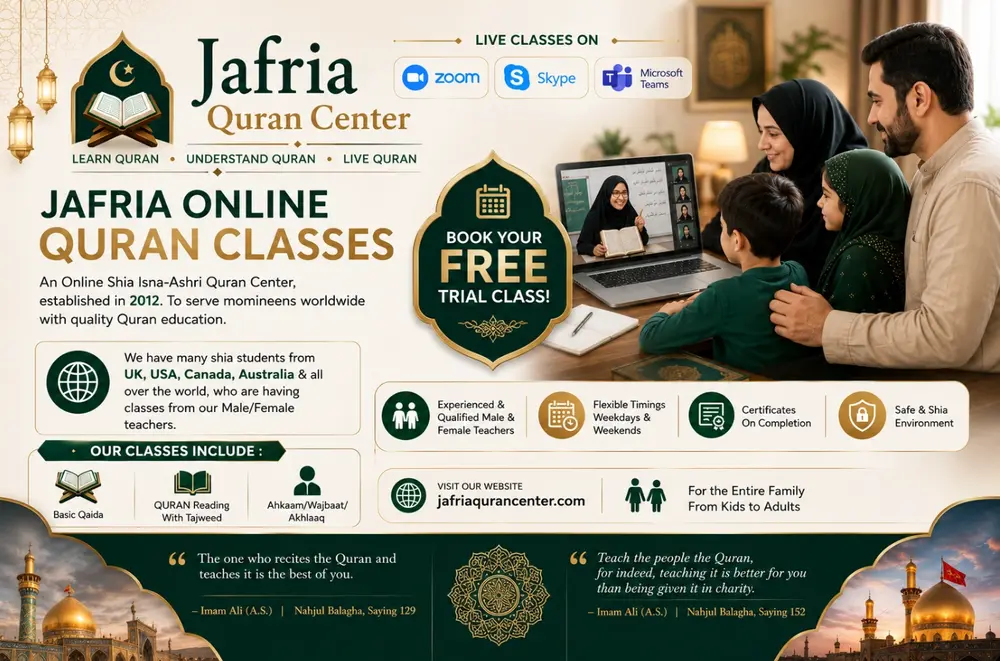
We built our teaching model around exactly these concerns, because they’re the same ones our own students’ families raised with us since 2012. Every teacher on our team — male and female — is selected specifically for grounding in Shia Ithna-Asheri teachings, not just general Quran fluency, and lessons follow a structured path: Basic Qaida with Tajweed, then Quran recitation, then Tafseer-ul-Quran, and eventually Nahjul Balagha and Sahifa Sajjadiya for students who want to go further.
Every class is one-on-one, scheduled around your time zone rather than ours, and every new student starts with a free trial class — no payment, no long-term commitment, just a real lesson so you can judge for yourself. Our monthly hadya (fee) is based on how many days a week you’d like classes, and if a family genuinely can’t afford it, we teach for free. No student is turned away over cost.
If you’re currently searching for an online Shia Quran teacher and want to see what a properly structured, one-on-one lesson actually looks like, book your free trial class — there’s no obligation to continue afterward if it’s not the right fit.
Quick Answers to Common Questions
What age should my child start learning Quran? Most teachers recommend starting as soon as a child can recognize letters and sit through a short structured activity — typically around age 5 or 6 — though it’s rarely too early to begin with simple letter recognition through play.
Is one-on-one really necessary, or is group teaching fine for beginners? Group classes can work for very informal introduction, but for actual Tajweed correction — fixing how a specific letter or elongation is being pronounced — a teacher genuinely needs to hear and correct that student directly, which group formats make difficult.
How do I know if a teacher is really trained in Shia teachings, or just says so? Ask specific questions: what’s the next stage after Qaida? Do they teach Tafseer or Nahjul Balagha eventually? A teacher who can answer clearly and specifically is a much stronger sign than a general reassurance.
Do I have to sign up for a long-term schedule to get a trial? No reputable center should ask for that. If a trial class requires a long-term commitment upfront, treat that as a red flag rather than normal practice.
Ready to see the difference a properly trained Shia Quran teacher makes? Book a free trial class with Jafria Online Quran Center today, or browse our full course path from Basic Qaida through Nahjul Balagha.